

10
Nov
IOSH HHSRS Certified Surveyor: Why Both Qualifications Matter
IOSH HHSRS Certified Surveyor: Why Both Qualifications Matter
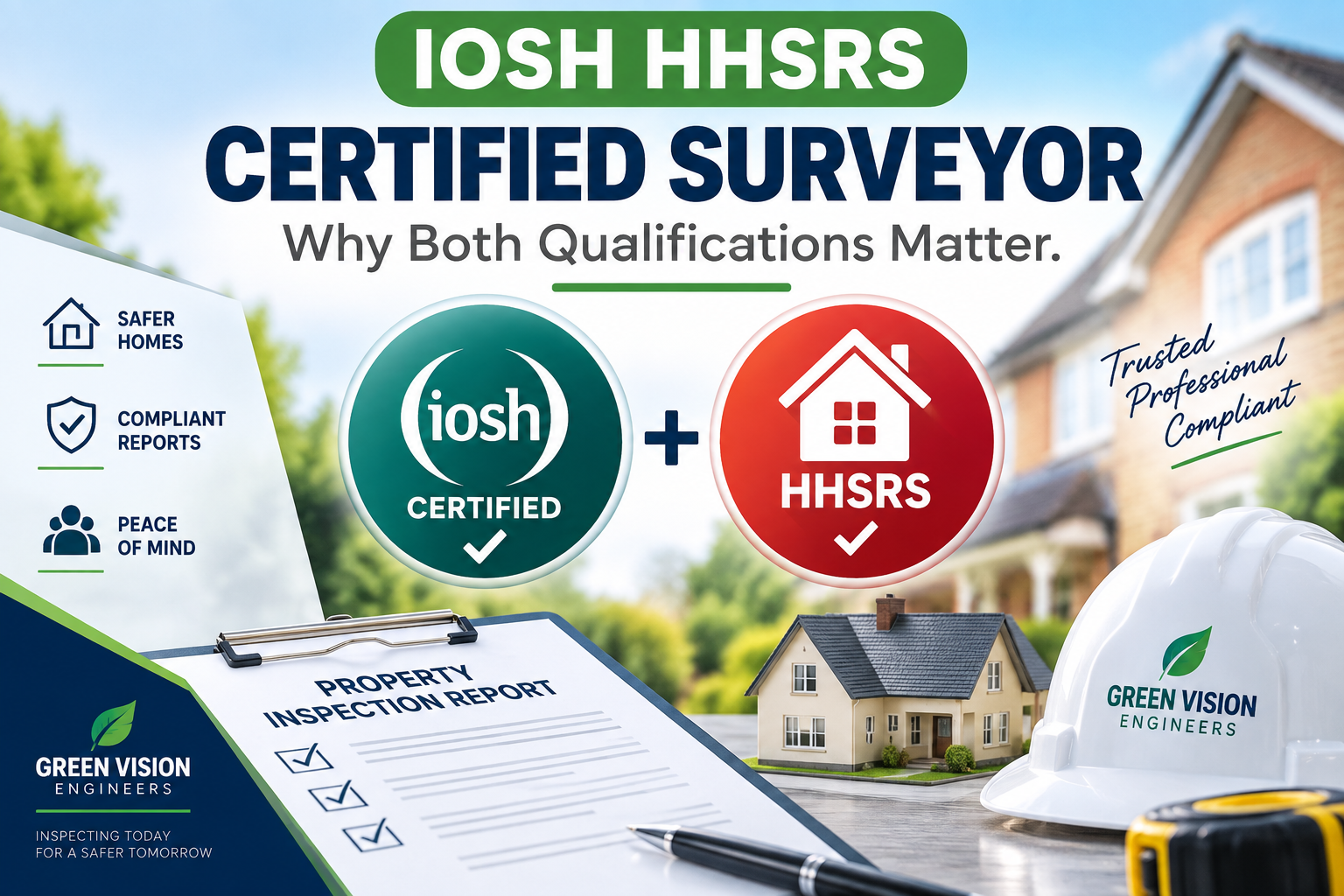
An IOSH HHSRS certified surveyor isn’t one single credential. It’s actually two different things working together. One covers qualified surveyor requirements and broad health and safety competency. The other covers specific professional body membership in housing risk assessment. Understanding the difference tells you far more than the phrase “certified surveyor” alone ever could.
What IOSH Actually Certifies
IOSH stands for the Institution of Occupational Safety and Health, the UK’s chartered body for health and safety professionals. Graduate membership demonstrates genuine, recognised training in identifying and managing risk across any environment, not housing specifically. This matters for a clear reason. It confirms a surveyor understands risk assessment as a discipline, the methodical, evidence-based approach that separates a proper inspection from a quick visual once-over.
What HHSRS Actually Certifies
HHSRS works differently. It isn’t a membership body like IOSH. Instead, the Housing Health and Safety Rating System is a specific risk assessment methodology. It was introduced under the Housing Act 2004. Local authorities and qualified assessors use it to evaluate hazards in residential properties. Being HHSRS-certified means a surveyor has completed dedicated training in applying this exact framework. This covers categories like damp, excess cold, and structural safety, rather than general workplace risk.
Why Two Separate Qualifications Exist at All
It’s worth asking why one combined qualification doesn’t cover everything already. The answer comes down to scope. IOSH exists to certify risk management as a broad professional discipline, applicable to factories, offices, construction sites, almost any setting. HHSRS exists specifically because housing has its own hazards, categorised and scored in a way general health and safety training doesn’t address. Neither body was designed to replace the other, which is exactly why a genuinely well-qualified surveyor holds both rather than treating one as sufficient.
Why the Combination Matters More Than Either Alone
Consider what happens with only one qualification. A surveyor with general health and safety training alone might miss housing-specific hazards HHSRS is designed to catch. A surveyor trained only in HHSRS, without the broader risk-assessment grounding IOSH provides, might apply the framework mechanically. The judgement genuine experience brings could be missing. Together, the two qualifications cover both the general discipline and the housing-specific application. That combination is exactly what a property inspection report needs.
What This Means for Your Report
Every report our team produces reflects both qualifications working together. Our surveyors check room measurements and occupancy calculations against the Housing Act 1985 with the same rigour HHSRS demands. Hazard assessments draw on the broader risk-management training IOSH represents. This isn’t two separate processes bolted together. It’s a single, properly qualified assessment. That assessment addresses both what the Housing Act 1985 requires and what genuine housing safety expertise demands.
Frequently Asked Questions
Is IOSH membership the same as being HHSRS-certified?
No. They’re separate qualifications covering different things. IOSH covers general health and safety competency. HHSRS covers specific housing hazard assessment training.
Can a surveyor have one qualification without the other?
Yes, and it happens. This is exactly why checking for both, rather than assuming one implies the other, genuinely matters when choosing a provider.
Does HHSRS certification come from a professional body like IOSH does?
Not in the same way. HHSRS is a government-created methodology, so certification reflects completed training in applying it, rather than membership in a chartered institution.
Why do some providers only mention one certification, not both?
This is worth asking about directly. A provider genuinely holding both should be happy to confirm this clearly, rather than leaving you to assume.
Does holding both qualifications guarantee a report gets accepted?
No single credential guarantees an outcome. What these qualifications do is give you confidence the assessment itself met a genuinely high, well-rounded standard.
How can I verify a surveyor’s IOSH or HHSRS credentials myself?
IOSH membership is generally verifiable through their official channels. For HHSRS, ask the provider directly for evidence of training, since it isn’t a public membership register in the same way.
Does a surveyor need to renew these qualifications periodically?
Professional bodies like IOSH typically require ongoing membership and continued professional development, so a genuinely current qualification reflects more than a one-off course completed years ago.
Would a surveyor with a background in a related field, like construction, need both qualifications too?
Yes. A related background is genuinely useful experience, but it doesn’t substitute for the specific IOSH and HHSRS training this kind of report relies on. Background and qualification are two different things worth checking separately.
Meet Our Certified Surveying Team
Every inspection we carry out reflects both IOSH and HHSRS training working together, not just a certificate on a wall. Get in touch to find out more about the people who’ll actually be measuring your property.
Talk to Green Vision Engineers. Landline: 0203 488 4930 or Mobile/WhatsApp: 07912 351 329.
See our About Us page to meet the team, explore our Green Vision Immigration Services for full advisory support, or contact us with any questions. More answers on our FAQs page.
Get in touch with us today
Talk to Green Vision Engineers Mobile: 07912 351 329 or Office 0203 488 4930 about how we can help with your property inspection report regarding immigration purposes, English language courses, including life in the UK preparation courses, Food Safety & Health and safety courses or planning permission & loft conversion. You’ll be speaking to competent trainers and inspectors who take a practical and professional approach to meeting your specific requirements.
© 2026 Green Vision Training & Engineering. All Rights Reserved.