

01
Sep
Room Standard vs Bedroom Standard: What’s the Difference, and Which Applies to You?
Room Standard vs Bedroom Standard: What’s the Difference, and Which Applies to You?
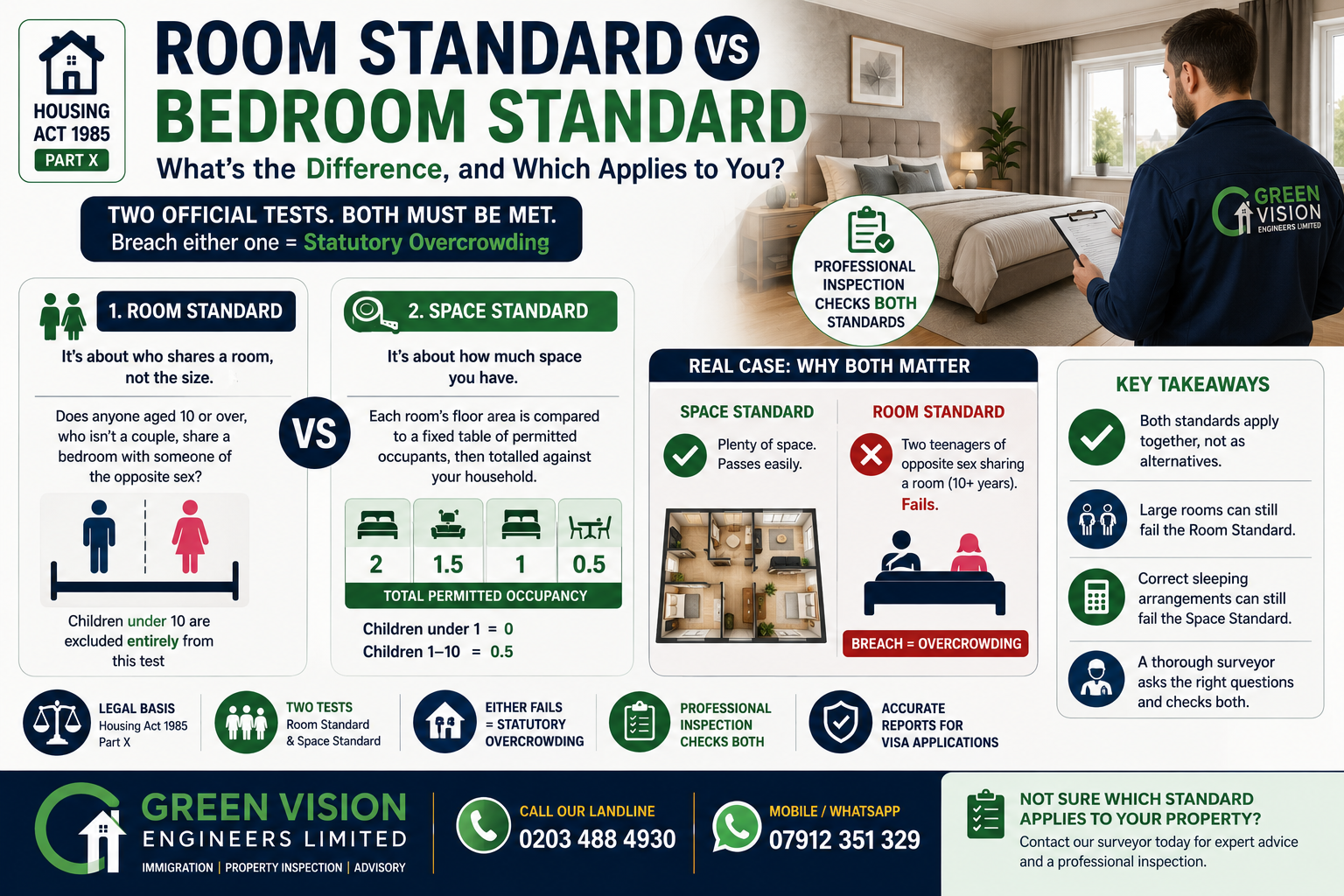
If you’ve come across the term “bedroom standard” while researching UK overcrowding rules, it’s worth clearing something up straight away. It isn’t one of the two official tests written into the Housing Act 1985. The two real tests are the Room Standard and the Space Standard. “Bedroom standard” is an informal phrase some guides use as a stand-in for the Space Standard’s room-by-room calculation, not a separate legal category of its own.
What the Room Standard Actually Tests
The Room Standard has nothing to do with square footage. It asks one specific question: does anyone aged 10 or over, who isn’t a couple, have to share a bedroom with someone of the opposite sex? Under Section 325 of the Housing Act 1985, children under 10 are left out of account entirely for this specific test, not weighted or partially counted, simply excluded from the calculation altogether. A property can have enormous bedrooms and still breach the Room Standard if the wrong two people end up sharing a room.
Worth being precise about here, since this is exactly where the two tests get confused: the Space Standard treats children differently. Under Section 326, a child under 1 counts as zero, and a child aged 1 to 10 counts as half a unit, not full exclusion. The “under 10 excluded” rule applies specifically to the Room Standard’s opposite sex sharing test, while the Space Standard uses its own separate age weighting when calculating total occupancy against floor area.
What People Usually Mean by “Bedroom Standard”
When people refer to a bedroom standard, they’re almost always describing the Space Standard, the calculation that compares each room’s floor area against a fixed table of permitted occupants, then totals those figures against the actual household. Our detailed walkthrough of what happens if your property is overcrowded covers this calculation in full, including how room size translates into permitted occupancy.
Why Both Tests Apply Together, Not as Alternatives
This is the part that trips people up most. The Room Standard and the Space Standard are not competing options where you pick whichever suits your property better. Both apply simultaneously, and a property is considered statutorily overcrowded if it breaches either one. Passing the Space Standard comfortably says nothing about whether the Room Standard is also satisfied, and vice versa.
A Case That Shows Why This Matters
A household we assessed had genuinely spacious bedrooms throughout, more than enough floor area to satisfy the Space Standard several times over. On paper, it looked like an easy pass. The issue turned out to be the Room Standard specifically: two teenagers of the opposite sex, both well over 10, were sharing what the family assumed was a perfectly adequate large bedroom. Square footage was never the problem. The sleeping arrangement itself was the breach, and no amount of extra floor space would have fixed it without separating the two teenagers into different rooms.
What a Rushed Assessment Can Miss
A quick tape measure exercise can confirm floor areas reasonably fast, which is exactly why the Space Standard sometimes gets treated as the whole job. The Room Standard requires actually asking who sleeps where, and confirming ages and relationships, questions a rushed or remote assessment can easily skip if a family doesn’t volunteer the detail unprompted. A thorough surveyor asks these questions directly rather than assuming a large enough property means the sleeping arrangement is automatically fine.
Checking Both, Not Just One
Because these are two entirely separate tests, checking only one and assuming the other automatically follows is a common and avoidable mistake. Large rooms can mask a Room Standard breach. A technically correct sleeping arrangement can still sit inside a property that fails the Space Standard once the numbers are run properly. A professional inspection checks both, rather than treating a pass on one as evidence for the other.
Full detail on the legislation itself sits in Part X of the Housing Act 1985, and Shelter England’s guidance on checking if a home is overcrowded explains both tests side by side if you’d like to see the official framing directly.
Frequently Asked Questions
Is “bedroom standard” ever used as an official legal term?
No. The Housing Act 1985 refers only to the Room Standard and the Space Standard. Bedroom standard is informal shorthand some guides use for the Space Standard specifically.
Can a property fail the Room Standard while comfortably passing the Space Standard?
Yes, and this is exactly the scenario in the case above. Plenty of floor area doesn’t resolve an opposite sex sharing issue under the Room Standard.
Do professional inspectors check both standards automatically, or do I need to request each one?
A proper inspection checks both as standard practice, since either one breaching counts as statutory overcrowding regardless of the other’s result.
Does having unusually large bedrooms make the Room Standard irrelevant?
No. Room size has no bearing on the Room Standard at all. It is purely about who is sharing a room with whom.
Which of the two standards tends to cause more problems in practice?
Both cause genuine issues, though the Space Standard tends to be the one applicants underestimate, while the Room Standard is the one they simply forget to check separately.
Would a family need to disclose sleeping arrangements themselves, or does a surveyor figure this out unprompted?
A thorough surveyor asks directly about who sleeps where, rather than relying on the family to volunteer it. This is exactly the kind of detail a rushed assessment can miss.
Not Sure Which Standard Applies to Your Property?
Ask our surveyor directly. We’ll check both the Room Standard and the Space Standard properly, rather than assuming a pass on one means you’re covered on the other.
Talk to Green Vision Engineers. Landline: 0203 488 4930 or Mobile/WhatsApp: 07912 351 329.
See our Property Inspection Report London for UK Visas and Immigration page, explore our Green Vision Immigration Services for full advisory support, or contact us with any questions. More answers on our FAQs page.
Get in touch with us today
Talk to Green Vision Engineers Mobile: 07912 351 329 or Office 0203 488 4930 about how we can help with your property inspection report regarding immigration purposes, English language courses, including life in the UK preparation courses, Food Safety & Health and safety courses or planning permission & loft conversion. You’ll be speaking to competent trainers and inspectors who take a practical and professional approach to meeting your specific requirements.
© 2022 Green Vision Training & Engineering. All Rights Reserved.